What it is
Dowsing uses pendulums or rods to tap into perceived energetic or intuitive information.
Dowsing is a divinatory practice that uses tools like pendulums or rods to access energetic information and gain guidance on questions or...
At a glance
What it is
Dowsing uses pendulums or rods to tap into perceived energetic or intuitive information.
Why explore it
It offers a symbolic, structured way to explore intuition and find clarity during uncertain moments.
How it’s experienced
A practitioner or you pose questions while observing subtle movements of a pendulum or rods.
Evidence context
Dowsing is a longstanding cultural tradition, though science has not confirmed how or whether it works.
See the evidence snapshotSafety
It is low-risk as a reflective tool, but never use it to replace medical care or major decisions.
See staying safeHistory & Origin
Dowsing involves using tools such as pendulums or rods to access energetic information and guidance.
Dowsing has ancient roots spanning multiple cultures and centuries. Evidence suggests dowsing-like practices were used in China, Egypt, and Rome, though documentation is limited. The practice became more formalized in medieval Europe, particularly in Germany during the 15th and 16th centuries, where it was employed to locate water sources and mineral deposits—uses that persist today.
During the Renaissance, dowsing gained popularity among scholars and natural philosophers who viewed it as a method of accessing hidden knowledge through sympathetic resonance with natural forces. The practice was sometimes associated with alchemy and occult philosophy, though it also maintained practical applications in agriculture and mining. By the 17th and 18th centuries, dowsing had spread throughout Europe and was increasingly adopted in America.
In the 19th and 20th centuries, dowsing evolved beyond water and mineral location to encompass broader spiritual and healing applications. Practitioners began using dowsing for health assessment, energy work, and obtaining answers to personal questions. The rise of New Age and metaphysical movements in the late 20th century expanded dowsing's association with energy healing and spiritual guidance.
Today, dowsing remains practiced globally by individuals seeking spiritual insight, energy assessment, and practical information. While some applications like water location have historical use in certain contexts, the practice is primarily understood within metaphysical and complementary health frameworks rather than scientific evidence.
Mechanism
Dowsing is best framed as a traditional, symbolic, energetic, reflective, or spiritual practice rather than a validated medical mechanism. Practitioners may use ritual, attention, sound, imagery, touch-free work, cards, symbols, prayer, or intention to support meaning-making and a sense of connection. People may explore it for reflection, calm, or spiritual context, while health claims should remain cautious and personal. Dowsing relies on the practitioner holding a tool—typically a pendulum, Y-shaped rod, or L-shaped rods—while focusing on a question or intention.
Your first visit
A typical session outline to help you feel prepared
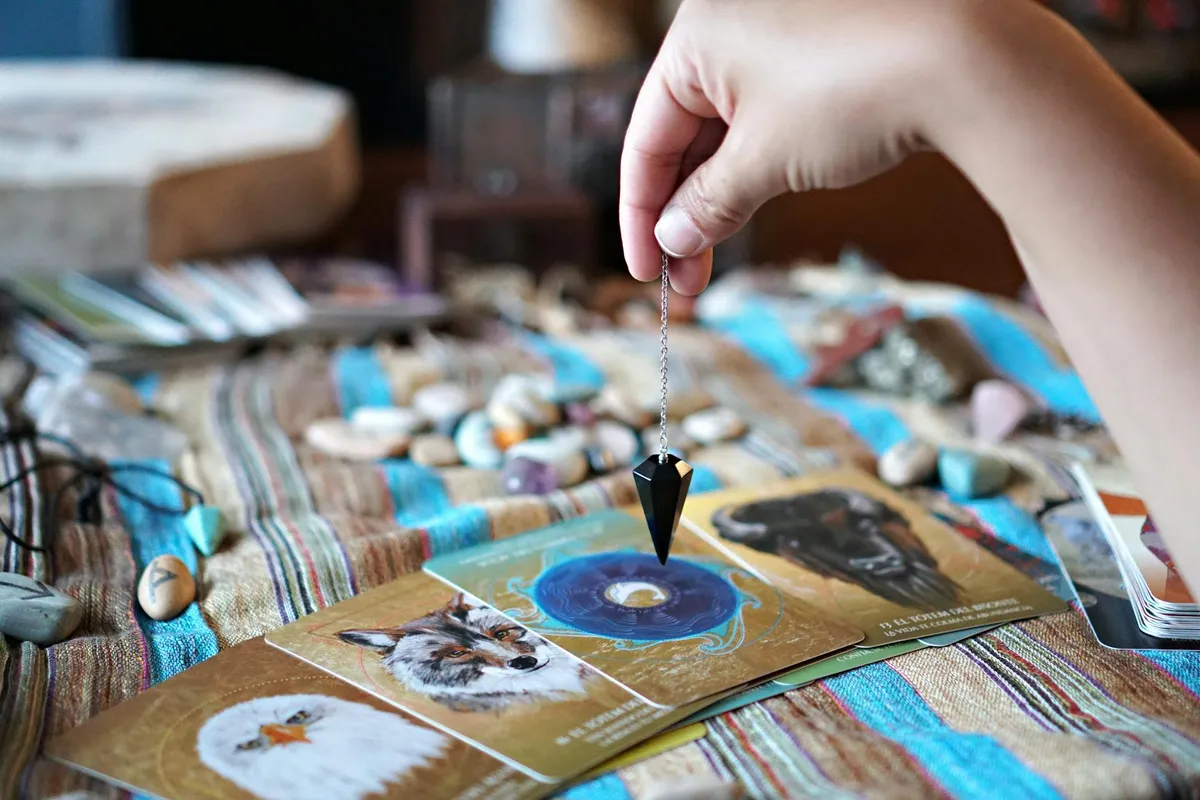
A dowsing session guides you through a focused, intuitive exploration using tools like a pendulum or divining rods to uncover insights about your questions and energy.
Your practitioner greets you and invites you to share what you're hoping to explore, whether it's a personal decision, energy concern, or a specific question you'd like clarity on.
The practitioner shows you the dowsing tool they'll be using, such as a pendulum or L-rods, and briefly explains how they interpret its movements to receive yes, no, or directional responses.
Before diving in, the practitioner demonstrates the tool's baseline responses by asking simple known questions, so you can see how it establishes its yes and no signals for the session.
The practitioner quiets their mind and enters a calm, receptive state, sometimes with a brief moment of stillness or intention-setting, to help them connect clearly with the dowsing process.
Working through your topics one at a time, the practitioner holds the tool and poses specific questions aloud or silently, observing its movements to gather responses and insights for you.
As the session unfolds, the practitioner explains what each movement or direction means in context, helping you understand how the information relates to your situation or question.
You're encouraged to share how the insights land for you and ask follow-up questions, making the session a collaborative conversation rather than a one-way reading.
The practitioner wraps up by summarizing key themes that emerged and may suggest journaling, sitting with the insights, or returning for further exploration as you feel called to.
The Evidence
What research, tradition, and honest reflection tell us about dowsing as a metaphysical practice.
Dowsing is a metaphysical practice without scientific validation
Controlled studies consistently show dowsing performs no better than chance. Its value lies within a metaphysical and intuitive framework, not an evidence-based one, and it should not be used as a substitute for professional assessment.
Multiple double-blind experiments testing dowsing for water and mineral location have returned null results. Researchers attribute apparent successes to unconscious movement, confirmation bias, and selective recall. No peer-reviewed evidence supports the proposed mechanisms of subtle energy or information field access.
Practitioners understand dowsing as a way of accessing subtle energies, subconscious awareness, or universal information fields. These concepts sit outside testable scientific frameworks. For those who engage with metaphysical perspectives, dowsing may hold personal or spiritual meaning that is not reducible to empirical outcomes.
Documented use spans medieval Europe, where dowsing was applied in mining and agriculture, through to broader spiritual applications in the 19th and 20th centuries. Long historical use reflects cultural significance but does not itself constitute evidence of effectiveness under controlled conditions.
When used as a prompt for self-reflection or intention-setting, dowsing may support personal clarity for some individuals. This subjective value is distinct from any claim of objective accuracy. Approaching it as a reflective practice, rather than a reliable information source, sets realistic expectations.
Avoid making significant medical, financial, or legal decisions based solely on dowsing guidance. It is not appropriate as a standalone approach for physical symptoms, mental health concerns, or any situation requiring professional evaluation. Seek practitioners who are transparent about what dowsing is and is not.
Reputable dowsing practitioners will not claim to assess or address specific health conditions, make definitive predictions, or promise measurable results. Be cautious of anyone presenting dowsing as a reliable health tool. Good practitioners frame it clearly as a metaphysical or intuitive practice.
Safety first
General guidance to help you decide whether this approach is appropriate for you. This is informational only and not a substitute for medical, psychological, or professional advice.
If you are pregnant, managing a health condition, recovering from injury or surgery, or taking medication, consult a qualified healthcare professional first.
Some situations call for extra care or a different approach. Share any conditions, injuries, or sensitivities with your practitioner before your first session.
Look for clear boundaries, transparent pricing, and practitioners who avoid fear-based claims or pressure to book frequent sessions.
Mild, short-lived effects such as tenderness, tiredness, or temporary soreness can occur. Rest, hydrate, and tell your practitioner how you respond.
For you?
A simple, human way to weigh it up. This is general guidance, not personal medical advice — a qualified practitioner can advise on your situation.
Gyfts is a discovery platform, not a medical provider. Nothing here diagnoses, treats or replaces professional care. In an emergency, contact your local emergency number.
Explore approaches
Other practices people often explore alongside dowsing.
In their words
FAQ
No. Dowsing lacks robust scientific evidence supporting its mechanism or effectiveness beyond placebo effect. Research attempting to validate dowsing under controlled conditions has consistently produced null or negative results. Dowsing is considered a traditional or metaphysical practice rather than a science-based modality. It may offer value as a tool for reflection and intuitive exploration, but not as a reliable method for obtaining factual information.
You'll discuss your question or intention with the practitioner, who will then use dowsing tools—usually a pendulum or rods—while focusing on your concern. The tools are believed to respond to energy or subconscious cues through subtle movements. The practitioner interprets these movements as answers or guidance. Sessions typically last 30–60 minutes and conclude with the practitioner sharing their interpretation.
This varies based on your needs and goals. Some people seek a single session for a specific question, while others return regularly for ongoing guidance. There is no standard protocol. Frequency should be determined by your comfort level, budget, and whether you find the practice helpful. Avoid practitioners who insist on frequent sessions without clear reasoning.
No. Dowsing cannot diagnose medical conditions and should never be used instead of clinical assessment. If you have health concerns, consult a qualified healthcare provider. Some practitioners may claim to assess energy imbalances or energetic blockages, but these are not medical diagnoses and are outside the scope of evidence-based medicine.
Pendulums are weighted objects suspended from a chain or string, typically held in the hand. Dowsing rods are usually L-shaped or Y-shaped implements held loosely in both hands. Both are believed to respond to subtle energetic shifts or unconscious movements. The choice is largely based on practitioner preference and client comfort. Neither has proven advantage over the other in research.
Yes. Many resources teach basic dowsing techniques, and some people report success using dowsing tools independently. However, self-dowsing may be subject to confirmation bias and unconscious suggestion. If you're interested in learning, seek instruction from experienced practitioners or reputable educational sources. Keep realistic expectations about results.
Dowsing itself carries minimal physical risk. However, relying on dowsing for medical decisions, avoiding necessary healthcare, or following dowsing advice that contradicts professional guidance can be harmful. Use dowsing as a complementary tool for reflection and spiritual exploration, not as a replacement for medical care or professional advice in important life domains.
References
Educational sources that inform this overview. Inclusion is for context and does not imply endorsement.
Full citations are maintained by the Gyfts editorial team and reviewed periodically.
Keep exploring
Browse practitioners, explore honest overviews, and take what you learn to a conversation — at your own pace.