What it is
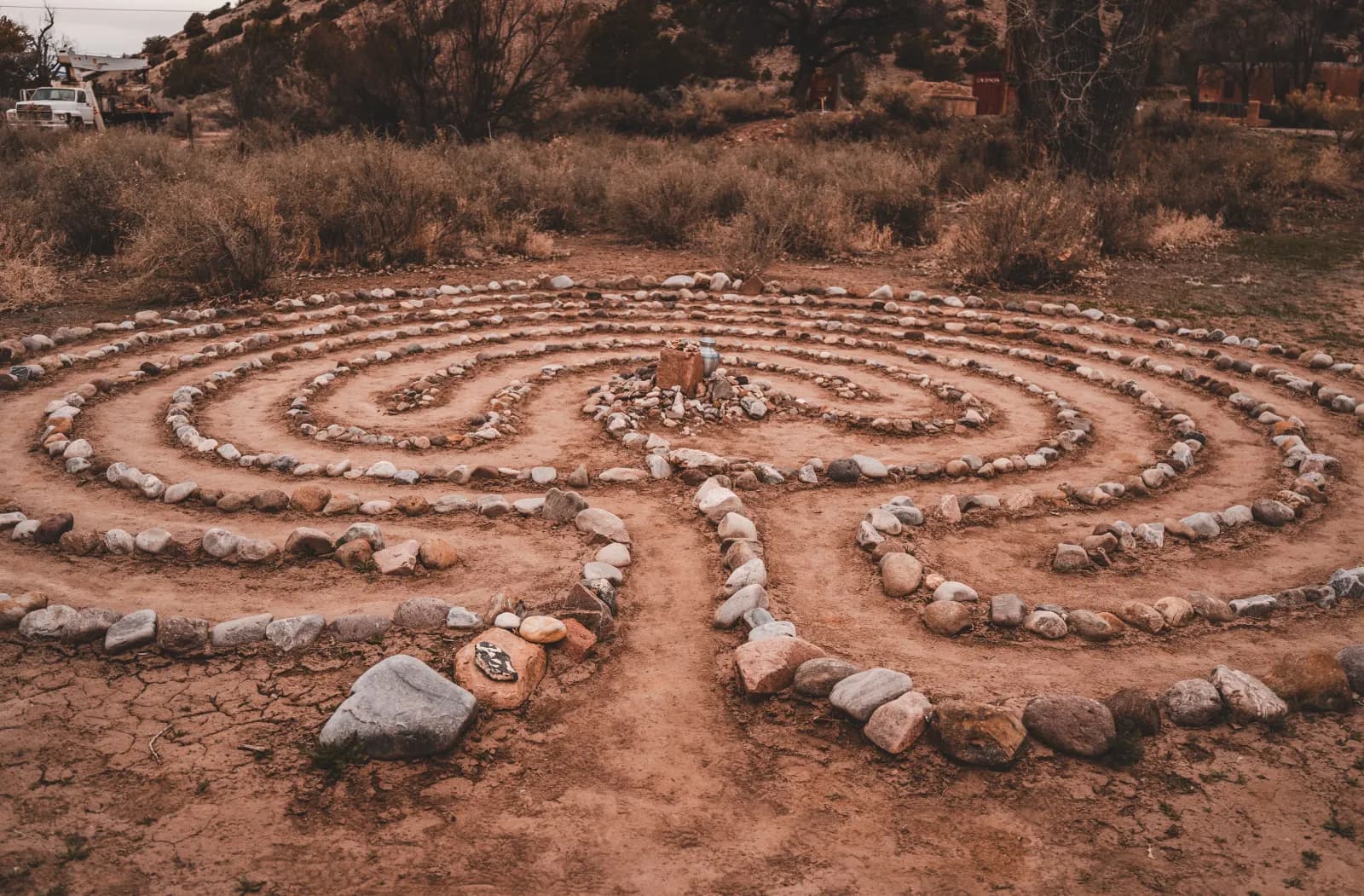
A winding, single-path walk with no dead ends, designed to invite quiet reflection.
Walk the path inward. Find your center.
At a glance
What it is
A winding, single-path walk with no dead ends, designed to invite quiet reflection.
Why explore it
May ease stress, support grief, and encourage mindfulness through slow, rhythmic movement.
How it’s experienced
You walk a spiral pattern slowly and silently, often pausing at the center for reflection.
Evidence context
Rooted in tradition and personal accounts rather than clinical research, so weigh that honestly.
See the evidence snapshotSafety
Generally safe for most people, though those with balance issues or trauma may want extra support.
See staying safeHistory & Origin
Labyrinth walking is a contemplative movement practice in which a person follows a single, winding path to a central point and back out again. Unlike a maze, a labyrinth has no dead ends or wrong turns — the path leads inevitably inward and then outward, offering a structured yet meditative journey. This quality makes it accessible to people of all ages and physical abilities, and it has been embraced across a wide range of spiritual, therapeutic, and wellness contexts.
The practice is often described as a form of walking meditation, combining gentle physical movement with focused attention. Participants are encouraged to move at their own pace, breathing intentionally, releasing mental chatter, and simply following the path. Some people use the inward walk for reflection or intention-setting, the center as a space for stillness or prayer, and the outward walk as a time for integration or renewed clarity. Others approach the experience with no specific goal, allowing whatever arises to surface naturally.
Labyrinth walking is categorized within the metaphysical domain, and its benefits are understood primarily through the lens of traditional use, personal experience, and qualitative reports rather than clinical research. Proponents suggest it may be associated with reduced stress, a greater sense of calm, emotional processing, and a felt sense of spiritual connection. It is used in hospital chaplaincy programs, retreat centers, schools, hospice settings, and community spaces around the world, reflecting broad cultural resonance even in the absence of robust scientific validation.
Labyrinth patterns have appeared across human cultures for at least four thousand years, with ancient examples found in rock carvings, pottery, and floor mosaics across Europe, the Mediterranean, India, and the Americas. The classical seven-circuit labyrinth design, often called the Cretan labyrinth, is among the oldest known geometric symbols in the world. In Greek mythology, the labyrinth was associated with the story of the Minotaur, lending it an enduring archetypal resonance around themes of journey, transformation, and the encounter with the unknown.
During the medieval period in Europe, elaborate labyrinths were inlaid into the floors of Gothic cathedrals, most famously at Chartres Cathedral in France. These were used as symbolic pilgrimage paths — a way for worshippers to undertake a spiritual journey toward the sacred center without traveling to distant holy sites. This tradition deeply shaped the Western understanding of labyrinth walking as a devotional and contemplative practice. In more recent decades, the practice has been revived and broadened beyond religious contexts, finding a home in hospitals, schools, wellness retreats, and public parks worldwide.
Mechanism
Labyrinth walking is thought to support wellbeing through a combination of intentional movement, symbolic structure, and meditative focus.
Your first visit
A typical session outline to help you feel prepared
A labyrinth walking session guides you along a single winding path to the center and back, inviting quiet reflection and a gentle shift in perspective.
Your facilitator greets you warmly and explains the layout of the labyrinth, noting that unlike a maze, there are no dead ends — just one continuous path in and out.
Before you step onto the path, you're invited to hold a question, word, or intention in mind — something you'd like to reflect on or simply release during the walk.
You stand at the entrance for a moment to take a breath and signal to yourself that you're crossing from everyday thinking into a more inward, receptive state.
You begin following the winding path toward the center, moving at whatever pace feels natural — slow and deliberate, or a little quicker if that's what your body wants.
When you reach the center, you're welcome to pause as long as you like — sitting, standing, breathing, or simply noticing whatever thoughts or feelings arise.
You retrace the same path back toward the entrance, which often feels different from the inward journey — lighter, more open, or quietly integrative.
After stepping off the path, your facilitator may offer a moment for journaling or quiet conversation to help you carry any insights from the walk with you.
The Evidence
What the research does and does not say about labyrinth walking, and how to understand its place in a wellness context.
A contemplative practice with roots in tradition, not clinical trial data
Labyrinth walking is supported by thousands of years of cultural and spiritual use, but formal scientific research is very limited. Its value is primarily experiential and reflective rather than evidence-based in a clinical sense.
A small number of pilot studies — mostly in hospital and hospice settings — have noted participant-reported improvements in relaxation and emotional wellbeing. These studies are limited in scale and design, and no large controlled trials exist. The evidence base does not support firm conclusions about outcomes.
Its value is understood through personal experience, symbolic meaning, and contemplative tradition rather than measurable clinical outcomes. People engage with it for inner reflection, spiritual connection, or a sense of structured stillness. These are meaningful purposes that do not require clinical validation to be worthwhile.
From ancient rock carvings to medieval cathedral floors, labyrinths have served as symbols of journey and transformation across diverse traditions. The Chartres Cathedral labyrinth remains one of the most recognised examples of its use as a devotional walking path. This long history of use across cultures is the primary foundation of the practice.
Participants often describe the structured, no-wrong-turns path as mentally freeing — reducing the need for decision-making and allowing attention to settle. Reports of reduced stress, emotional processing, and a sense of renewed perspective are common. These are experiential accounts, not measured outcomes, and individual experiences vary widely.
Those with balance, gait, or joint concerns should check that the surface and duration suit their needs. The introspective nature of the practice may occasionally surface strong emotions — people with a history of trauma may prefer to engage alongside a therapist or trusted guide. This practice is not a substitute for professional assessment of any health concern.
It is not recognised by mainstream health authorities as a medical approach, and inflated outcome claims should be viewed with caution. It is best understood as a reflective and potentially meaningful experience rather than a solution to specific health concerns. Anyone managing a physical or mental health condition should continue working with qualified professionals.
Safety first
General guidance to help you decide whether this approach is appropriate for you. This is informational only and not a substitute for medical, psychological, or professional advice.
If you are experiencing severe distress, suicidal thoughts, psychosis, acute trauma, or another serious mental health concern, seek qualified support first.
This approach is not suitable for diagnosis, treatment instructions, or decisions that require medical, legal, financial, or professional advice.
Look for clear boundaries, transparent pricing, and practitioners who avoid fear-based claims or pressure to book frequent sessions.
Treat any insight as one reflective perspective, not absolute truth. Important decisions should be considered with appropriate professional support.
For you?
A simple, human way to weigh it up. This is general guidance, not personal medical advice — a qualified practitioner can advise on your situation.
Gyfts is a discovery platform, not a medical provider. Nothing here diagnoses, treats or replaces professional care. In an emergency, contact your local emergency number.
In their words
Before you book
FAQ
No prior beliefs or affiliations are required. Labyrinth walking can be approached from a secular, spiritual, or religious perspective depending on your own preferences. Many people find meaning in the practice simply as a form of walking meditation, without any metaphysical framing.
The duration varies depending on the size of the labyrinth and your personal pace. A full walk — inward, a pause at the center, and outward — may take anywhere from ten minutes to forty-five minutes. There is no correct speed, and participants are encouraged to move in whatever way feels natural.
Current evidence is limited and based primarily on traditional use and small qualitative studies rather than clinical trials. Some participants in healthcare settings have reported feeling more relaxed or emotionally settled after walking, but these accounts do not constitute clinical proof of efficacy. The practice is best understood as a complementary wellness activity rather than a medically validated treatment.
References
Educational sources that inform this overview. Inclusion is for context and does not imply endorsement.
Full citations are maintained by the Gyfts editorial team and reviewed periodically.
Keep exploring
Browse practitioners, explore honest overviews, and take what you learn to a conversation — at your own pace.