What it is
A guided practice that leads you into deep conscious rest, no flexibility needed.
Yoga Nidra (Nidra) is a guided yogic relaxation practice that induces a state of conscious rest between wakefulness and sleep, designed t...
At a glance
What it is
A guided practice that leads you into deep conscious rest, no flexibility needed.
Why explore it
It may ease stress, improve sleep, and bring emotional calm with minimal effort.
How it’s experienced
You lie still while a guide walks your awareness through body and breath for 20-45 minutes.
Evidence context
Early research suggests benefits for relaxation and sleep, though studies are still small-scale.
See the evidence snapshotSafety
Generally very safe, though trauma survivors do best with a trauma-informed instructor.
See staying safeHistory & Origin
Nidra is a yogic practice of guided relaxation and meditation for deep rest and rejuvenation.
Yoga Nidra has roots in ancient yogic philosophy and Tantric traditions, though its systematized form as practiced today was developed in the mid-20th century by Swami Satyananda Saraswati, a disciple of the renowned yoga master Swami Sivananda. Swami Satyananda formalized Yoga Nidra as a structured practice combining traditional yogic relaxation techniques with modern understanding of consciousness and the nervous system, making it accessible to contemporary practitioners. The practice draws from ancient texts describing prarabdha karma (karmic impressions stored in the subconscious mind) and the concept of sankalpa (intention-setting), which Satyananda integrated into a systematic guided protocol. From its origins in India during the 1960s, Yoga Nidra spread globally through yoga centers, wellness facilities, and scientific research programs, gaining recognition in therapeutic contexts for its effects on stress and sleep disorders. Today it is taught in hospitals, clinics, meditation centers, and online platforms worldwide, supported by growing interest in mind-body medicine and non-pharmacological stress management.
Mechanism
Nidra Yoga is usually understood through movement, breath, attention, and repeated practice. A session may invite the body to explore safer patterns, steadier pacing, or a more settled relationship with sensation. Some traditions describe this as balancing energy or awareness, while contemporary explanations may focus on coordination, nervous system regulation, mobility, and confidence. Experiences vary by person, teacher, setting, and consistency. Nidra is a yogic practice of guided relaxation and meditation for deep rest and rejuvenation.
Your first visit
A typical session outline to help you feel prepared
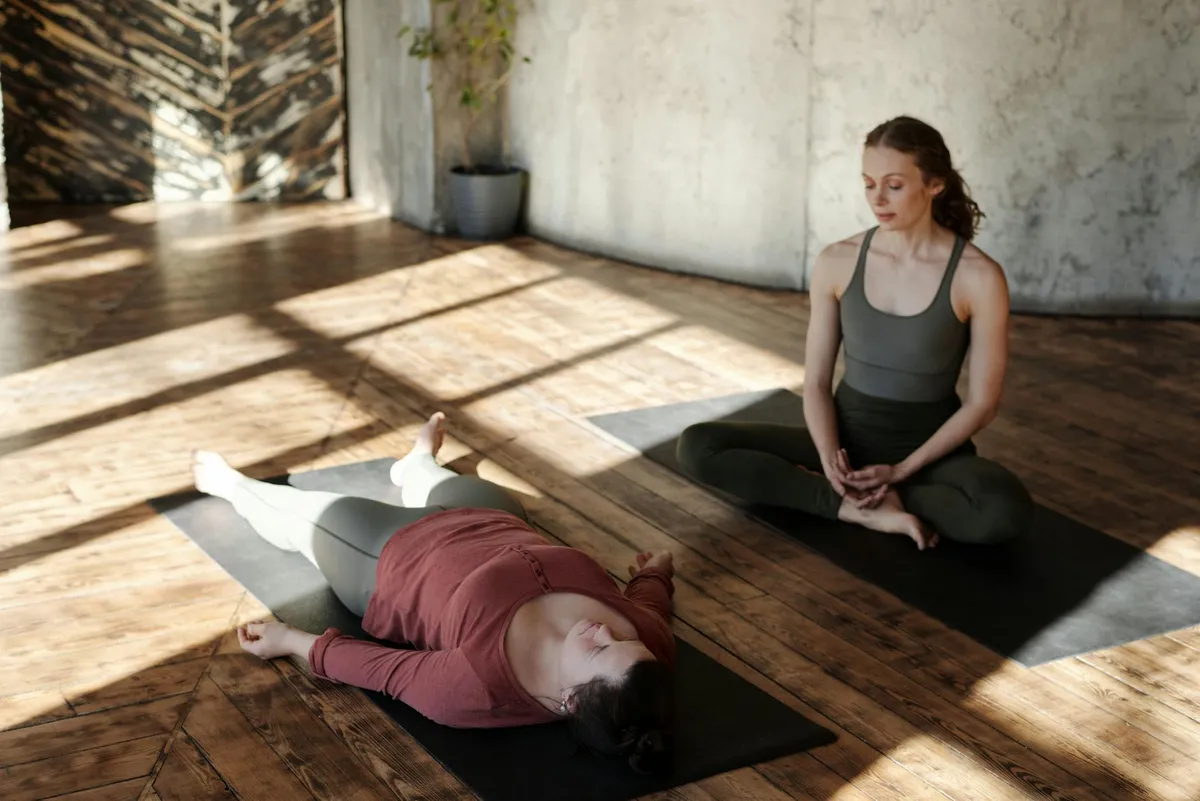
You'll lie still and be gently guided into a deeply restful state between sleep and waking, using breath, body awareness, and visualization.
Your guide greets you and invites you to find a comfortable position lying flat on your back, often on a mat or blanket. Pillows, bolsters, and an eye covering may be offered to help you feel fully at ease.
You'll be invited to silently choose a short personal intention, called a Sankalpa, such as a word or phrase that feels meaningful to you. This seed thought is planted at the start when the mind is most receptive.
The guide gently draws your attention to the natural rhythm of your breath, without asking you to change it. This helps your nervous system begin to slow down and signals to the mind that it is safe to let go.
You'll hear a slow, methodical sequence of body parts named one by one, from fingers to toes. You simply move your awareness to each spot as it is mentioned, which pulls the mind inward and releases physical tension.
The guide may offer pairs of opposite sensations, such as heaviness and lightness or warmth and cold, asking you to briefly imagine or feel each one. This technique helps suspend the thinking mind and
You're led through a series of vivid mental images, perhaps a candle flame, an open sky, or a quiet forest path. These arise and dissolve quickly, keeping awareness active while the body remains completely still.
The guide slowly and gently calls your awareness back to the room, your breath, and the sounds around you. You are given time to wiggle fingers and toes before being invited to open your eyes at your own pace.
A few quiet minutes are offered to simply lie still or sit up slowly before the session closes. You may feel dreamy, calm, or unusually clear-headed, and drinking water and moving gently afterward is encouraged.
The Evidence
What research says about Yoga Nidra, where the evidence is strong, and where gaps remain.
Growing research base with promising early findings
Yoga Nidra has attracted genuine scientific interest, with studies showing measurable effects on stress markers, sleep quality, and anxiety. The evidence base is promising but still limited by small sample sizes and inconsistent protocols.
Randomized controlled trials and observational studies have measured cortisol levels, heart rate variability, EEG patterns, and self-reported sleep and stress outcomes. Results are generally positive, but most studies involve small samples and lack standardized protocols. Findings are encouraging rather than definitive.
The most consistent findings relate to reduced perceived stress, improved sleep quality, and lower anxiety scores. Some studies also report benefits for chronic pain and blood pressure support. These outcomes align with the practice's known effects on the autonomic nervous system, though larger trials are needed to confirm them.
The practice integrates traditional concepts such as sankalpa (intention-setting) and awareness of consciousness states with structured guided relaxation. Developed in the 1960s, it has since spread into hospitals, clinics, and wellness settings globally. Its long experiential history complements, but is distinct from, its modern scientific evidence base.
Many published studies lack rigorous control conditions, use small samples, or rely heavily on self-report measures. Protocols differ significantly across studies, making comparisons difficult. Yoga Nidra is not a substitute for professional assessment or medical care, and evidence does not support its use as a standalone intervention for serious conditions.
People with active psychosis, untreated bipolar disorder, acute dissociative disorders, or uncontrolled seizure conditions should speak with a qualified health professional first. There are no absolute contraindications for most people. Practicing in a safe, comfortable environment with a qualified teacher reduces any potential for discomfort.
Qualifications and training standards vary internationally, so it is worth asking about a teacher's background and experience. For those managing mental health conditions or chronic illness, coordinating with a healthcare provider alongside Yoga Nidra practice is advisable. Many hospitals and wellness programs now offer structured sessions.
Safety first
General guidance to help you decide whether this approach is appropriate for you. This is informational only and not a substitute for medical, psychological, or professional advice.
If you are experiencing severe distress, suicidal thoughts, psychosis, acute trauma, or another serious mental health concern, seek qualified support first.
This approach is not suitable for diagnosis, treatment instructions, or decisions that require medical, legal, financial, or professional advice.
Look for clear boundaries, transparent pricing, and practitioners who avoid fear-based claims or pressure to book frequent sessions.
Treat any insight as one reflective perspective, not absolute truth. Important decisions should be considered with appropriate professional support.
For you?
A simple, human way to weigh it up. This is general guidance, not personal medical advice — a qualified practitioner can advise on your situation.
Gyfts is a discovery platform, not a medical provider. Nothing here diagnoses, treats or replaces professional care. In an emergency, contact your local emergency number.
Explore approaches
Other practices people often explore alongside nidra yoga.
In their words
FAQ
You lie comfortably on your back while a guide leads you through a systematic relaxation process lasting 20-45 minutes. The session includes body awareness, breath work, visualization, and intention-setting designed to induce a state of deep rest while maintaining awareness. Many people experience falling asleep, which is considered part of the therapeutic process.
Many people feel deeply relaxed and calm after just one session. However, cumulative benefits like improved sleep quality, reduced baseline anxiety, and emotional resilience typically develop with consistent practice over 4-8 weeks of 2-4 sessions weekly. Individual results vary based on practice frequency, openness, and personal circumstances.
Yes. After learning the practice with a qualified instructor, you can use recorded Yoga Nidra sessions at home. Many practitioners recommend a mix of live sessions and home practice. Recordings range from 15-60 minutes and are available through yoga centers, apps, and online platforms.
Yoga Nidra is distinct from both. Unlike sleep, you maintain a thread of awareness throughout. Unlike typical meditation, which often focuses on a single point, Yoga Nidra uses systematic body scanning, visualization, and intention to induce a specific state between waking and sleeping called yogic sleep.
Falling asleep is normal and beneficial, especially for people with sleep deprivation. The relaxation induces parasympathetic activation that promotes natural sleep. However, if you consistently sleep through entire sessions, discuss this with your practitioner—they may adjust the approach or explore underlying sleep issues.
No. Yoga Nidra requires no movement, flexibility, or prior yoga experience. It is completely passive and accessible to people of all ages, fitness levels, and abilities, including those with mobility limitations.
While both promote relaxation, Yoga Nidra is a more comprehensive system incorporating body awareness, breathwork, visualization, and subconscious intention-setting within a structured yogic framework. Progressive muscle relaxation focuses primarily on tensing and releasing muscle groups.
Research suggests Yoga Nidra may support anxiety management and trauma recovery by activating the parasympathetic nervous system and promoting emotional regulation. However, for PTSD and severe trauma, work with a trauma-informed instructor and coordinate care with a mental health professional.
References
Educational sources that inform this overview. Inclusion is for context and does not imply endorsement.
Full citations are maintained by the Gyfts editorial team and reviewed periodically.
Keep exploring
Browse practitioners, explore honest overviews, and take what you learn to a conversation — at your own pace.