What it is
Acupuncture needles meet calming sound vibrations to encourage relaxation and energy flow.
Acu Sound Therapy combines traditional acupuncture with sound vibrations and frequencies to enhance energy flow and promote relaxation

At a glance
What it is
Acupuncture needles meet calming sound vibrations to encourage relaxation and energy flow.
Why explore it
A gentle dual approach that may ease stress, anxiety, and tension while deepening body awareness.
How it’s experienced
You rest as fine needles are placed, then soothing sound frequencies wash over you in layers.
Evidence context
Both practices have limited research, so come with curiosity and realistic, informed expectations.
See the evidence snapshotSafety
Risk is low with a trained provider, but check with your doctor if you have implants or blood disorders.
See staying safeHistory & Origin
Acu Sound Therapy combines traditional acupuncture with sound vibration to enhance energy flow and relaxation.
Acu Sound Therapy represents a modern fusion of two ancient healing traditions: acupuncture from Traditional Chinese Medicine and sound healing practices found across various cultures. Acupuncture, with its 3,000-year history in China, has long been based on the concept of Qi (life energy) flowing through meridian pathways in the body. Sound healing has equally ancient roots, with cultures worldwide using drums, singing bowls, chants, and other vibrational tools for healing and spiritual purposes.
The integration of these modalities emerged in the late 20th and early 21st centuries as practitioners began exploring ways to enhance traditional acupuncture treatments. Pioneers in this field recognized that sound frequencies could potentially amplify the energetic effects of acupuncture by creating resonance within the body's tissues and energy systems. This approach draws from both Eastern concepts of energy meridians and Western understanding of vibrational medicine.
The practice gained traction among holistic health practitioners who observed that combining needle insertion with specific sound frequencies appeared to deepen relaxation responses and enhance treatment outcomes. Some practitioners incorporated Tibetan singing bowls, tuning forks calibrated to specific frequencies, or electronic sound generators into their acupuncture sessions. The modality has spread through alternative health networks, wellness centers, and integrative medicine clinics, particularly in North America and Europe, as interest in combining traditional and modern healing approaches continues to grow.
Mechanism
Acu Sound Therapy is generally framed as a guided process for attention, reflection, learning, and emotional integration. Depending on the method, a practitioner may use conversation, imagery, structured exercises, body awareness, or therapeutic techniques to help the person explore patterns and choices. It should not be presented as a standalone solution or a substitute for urgent care, but it may support self-understanding when practiced within an appropriate scope. During an Acu Sound Therapy session, fine needles are inserted at specific acupuncture points along meridian pathways, then sound frequencies—typically tuning forks, singing bowls, or tones calibrated to specific hertz—are applied directly to or near the needles or body.
Your first visit
A typical session outline to help you feel prepared
A blend of fine acupuncture needles and resonant sound frequencies work together to invite deep relaxation and restore your body's natural balance.
Your practitioner greets you and reviews a health intake form covering your current concerns, stress levels, sleep, and any conditions. This helps them shape a session that feels truly personal to you.
Using traditional Chinese medicine techniques, your practitioner gently reads your pulse on both wrists and observes your tongue. These quick, painless checks reveal patterns in your energy flow that
You'll lie fully clothed or with small areas of skin exposed on a comfortable treatment table. Your practitioner will let you know which areas they plan to work on and answer any questions before anything begins.
Ultra-fine, sterile single-use needles are placed at specific acupuncture points, often on the hands, feet, legs, or torso. Most people feel a brief, mild sensation followed by a pleasant heaviness or
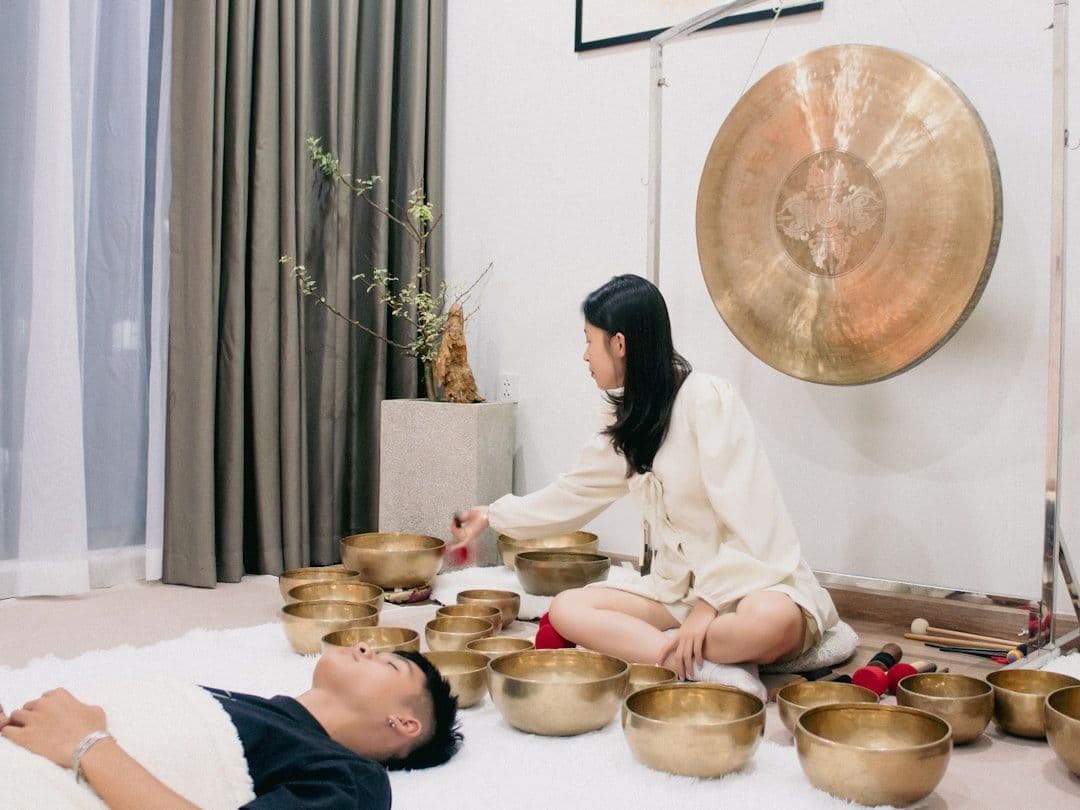
Once the needles are resting, your practitioner introduces tuning forks or singing bowls near and around your body. The vibrations move through your tissues, creating a humming warmth that deepens the
You rest quietly for roughly 20 to 30 minutes while sound continues to wash over you. Many people drift into a light, dream-like state — this is completely normal and a sign your nervous system is unwinding.
Your practitioner carefully removes all needles, checks in with how you're feeling, and may make a final pass with a tuning fork to help you integrate the session before you sit up slowly.
Before you leave, your practitioner shares simple suggestions like drinking extra water, resting if possible, and noticing any shifts in mood or sleep over the next day or two. A series of 6 to 8 sess
The Evidence
What research says about combining acupuncture with sound vibration, and what remains uncertain.
Component therapies have some research; the combined approach does not
Acupuncture and sound therapy each carry a modest individual research base, but Acu Sound Therapy as a combined modality has not been studied in large controlled trials. Most available evidence comes from small studies, case reports, and practitioner observation.
Acupuncture has a substantial research record for chronic pain, nausea, and some mental health concerns. Sound therapy shows emerging evidence for stress and anxiety reduction, though study quality varies. Research specifically examining their combined use is in early stages, relying mainly on pilot studies and practitioner reports rather than robust controlled trials.
As a holistic modality, it aims to support relaxation, body awareness, and nervous system regulation rather than targeting isolated symptoms. Practitioners integrate physical needle stimulation with acoustic vibration to encourage a whole-system response. This approach fits within the Gyfts Holistic category, where wellbeing is viewed as interconnected rather than compartmentalised.
Acupuncture originates from Traditional Chinese Medicine, with a history spanning approximately 3,000 years and a framework centred on Qi and meridian pathways. Sound healing has parallel ancient roots across many cultures, using vibration for wellbeing and ceremony. Their modern fusion emerged in the late 20th century as practitioners explored ways to combine these approaches.
The theoretical basis draws from Traditional Chinese Medicine and vibrational medicine concepts that are not fully validated by conventional scientific methods. Without large randomised controlled trials, it is not possible to confirm whether combining acupuncture with sound produces effects beyond either therapy alone. Individuals should weigh this uncertainty when making decisions about their care.
People with bleeding disorders, electronic medical implants such as pacemakers, active skin infections, or who are pregnant should consult a qualified healthcare provider before proceeding. Ensure your practitioner uses sterile single-use needles and follows recognised safety protocols. Temporary mild fatigue, minor bruising, or emotional responses after sessions are possible and generally short-lived.
Look for practitioners with recognised acupuncture qualifications from an accredited institution, as regulatory standards differ by country. Ask about their training in sound therapy and how they integrate both elements. Acu Sound Therapy is not a substitute for professional assessment of serious or undiagnosed health concerns, and a qualified practitioner should support rather than replace your existing healthcare.
Safety first
General guidance to help you decide whether this approach is appropriate for you. This is informational only and not a substitute for medical, psychological, or professional advice.
If you are pregnant, managing a health condition, recovering from injury or surgery, or taking medication, consult a qualified healthcare professional first.
Some situations call for extra care or a different approach. Share any conditions, injuries, or sensitivities with your practitioner before your first session.
Mild, short-lived effects such as tenderness, tiredness, or temporary soreness can occur. Rest, hydrate, and tell your practitioner how you respond.
Look for clear boundaries, transparent pricing, and practitioners who avoid fear-based claims or pressure to book frequent sessions.
For you?
A simple, human way to weigh it up. This is general guidance, not personal medical advice — a qualified practitioner can advise on your situation.
Gyfts is a discovery platform, not a medical provider. Nothing here diagnoses, treats or replaces professional care. In an emergency, contact your local emergency number.
Explore approaches
Other practices people often explore alongside acu sound therapy.
In their words
FAQ
A typical Acu Sound Therapy session involves an intake to understand goals and preferences, followed by guided techniques aligned to the approach, with time for questions and aftercare suggestions.
The number of sessions varies by goals, preferences, and individual response. Some people try a short series and then reassess with the practitioner.
Acu Sound Therapy integrates acupuncture points and meridian pathways with sound healing tools — typically tuning forks calibrated to specific frequencies that are placed on or near acupuncture points. The premise is that specific frequencies resonate with and clear energetic blockages in the meridian system in a similar way to needle stimulation, but without penetrating the skin. It draws on both Traditional Chinese Medicine theory and vibroacoustic medicine. Sessions are fully non-invasive and suitable for people who prefer not to receive needles.
You lie fully clothed on a treatment table while the practitioner assesses your energy through pulse or visual diagnosis, selects relevant meridian points, and applies activated tuning forks to specific locations on the body. Different forks correspond to different frequencies — some practitioners use forks calibrated to the frequencies of the five elements of TCM. The experience is deeply relaxing; many people notice warmth, tingling, or a sense of energy movement. Sessions typically last 45–60 minutes including consultation.
Yes — this is one of its primary applications. All the meridian and acupuncture point theory of Traditional Chinese Medicine can be accessed through sound vibration without any needles. People who experience needle phobia, have skin sensitivities, or simply prefer non-invasive approaches find Acu Sound Therapy an accessible alternative to traditional acupuncture. It is also particularly well-suited to children and elderly people for whom needle insertion may not be the most comfortable option.
References
Educational sources that inform this overview. Inclusion is for context and does not imply endorsement.
Full citations are maintained by the Gyfts editorial team and reviewed periodically.
Keep exploring
Browse practitioners, explore honest overviews, and take what you learn to a conversation — at your own pace.