What it is
An Indigenous Australian practice using story and ritual to access ancestral wisdom for healing.
Dreamtime Healing is an Indigenous Australian spiritual practice that connects individuals with ancestral wisdom and the Dreamtime throug...
At a glance
What it is
An Indigenous Australian practice using story and ritual to access ancestral wisdom for healing.
Why explore it
It may ease grief, anxiety, and life transitions by offering deep ancestral perspective and grounding.
How it’s experienced
A trained practitioner guides you through storytelling, imagery, and land-based teachings in a reflective space.
Evidence context
Grounded in thousands of years of Indigenous tradition, with support from lived community experience rather than clinical trials.
See the evidence snapshotSafety
Generally safe, but verify practitioner credentials and approach with cultural respect before beginning.
See staying safeHistory & Origin
Dreamtime Healing is an Indigenous Australian healing modality that connects individuals with ancestral wisdom.
Dreamtime Healing emerges from the spiritual and cultural traditions of Indigenous Australians, whose connection to the land and ancestors spans over 65,000 years. The Dreamtime (also called Dreaming) represents a sacred dimension of existence where ancestral beings created the land, established laws, and embedded spiritual knowledge into the landscape and oral traditions. This cosmology is foundational to Indigenous Australian culture, incorporating complex systems of kinship, land stewardship, and spiritual responsibility that have been maintained through ceremony, storytelling, and sacred practice across generations.
Traditional Indigenous healers and elders have long served as keepers of this knowledge, using Dreamtime connection as a means of healing, guidance, and cultural transmission. The practice encompasses land-based spirituality, ancestral communication, songlines (pathways of knowledge encoded in songs and stories), and sacred sites that hold spiritual power. While these practices are ancient, their adaptation into contemporary healing contexts represents a relatively recent formalization, as Indigenous Australian communities have increasingly sought to share and preserve their traditions in response to historical suppression and ongoing cultural revitalization efforts.
In modern times, Dreamtime Healing has been developed and offered by Indigenous practitioners who blend traditional knowledge with contemporary healing frameworks. This modality has gained attention within complementary health circles as interest in Indigenous wisdom systems has grown globally. However, practitioners emphasize the importance of cultural respect, proper training within Indigenous frameworks, and acknowledgment of the sacred nature of these traditions, as they represent living spiritual practices rather than cultural artifacts.
Mechanism
Dreamtime Healing is best framed as a traditional, symbolic, energetic, reflective, or spiritual practice rather than a validated medical mechanism. Practitioners may use ritual, attention, sound, imagery, touch-free work, cards, symbols, prayer, or intention to support meaning-making and a sense of connection. People may explore it for reflection, calm, or spiritual context, while health claims should remain cautious and personal. Dreamtime Healing typically involves guided meditation, storytelling, and ceremonial practices that draw on Indigenous Australian spiritual frameworks.
Your first visit
A typical session outline to help you feel prepared
A Dreamtime Healing session blends guided visualization, ancestral storytelling, and sound to help you connect with deeper wisdom and sacred inner landscapes.
Your practitioner opens with a warm conversation about what's weighing on you, what you're seeking, and any meaningful dreams or symbols that have shown up in your life lately.
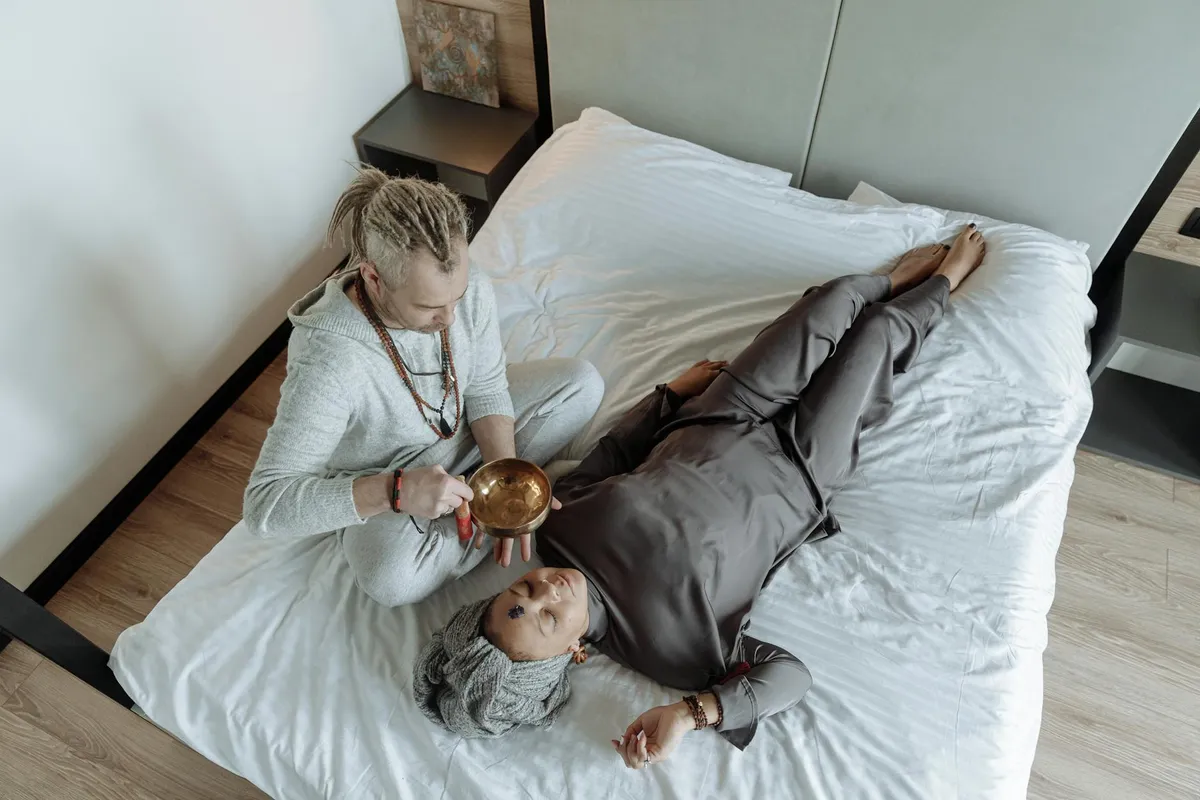
The practitioner prepares the session space using sound, such as a singing bowl or clapping sticks, to settle the energy and help both of you arrive fully present before the journey begins.
You'll be guided through slow breathing and body awareness to ease your mind into a receptive, relaxed state — similar to the threshold between waking and dreaming.
The heart of the session involves guided visualization into sacred landscapes drawn from ancestral dreaming traditions, where story, symbol, and imagery arise to offer guidance or reflection.
Your practitioner may weave in oral storytelling or live sound — voice, rhythm, or instrument — to deepen the journey and help meaningful themes surface from within you.
After the active journey, you rest quietly while the practitioner holds the space, allowing images, feelings, or insights to settle naturally without rushing you back to ordinary awareness.
You and your practitioner talk through what arose — symbols, feelings, or scenes — and explore what they might mean for your life circumstances and original intentions.
Your practitioner may suggest simple practices to carry the session's insights forward, such as journaling, spending time in nature, or noticing recurring symbols in your daily life.
The Evidence
What the research says, what tradition holds, and how to engage with Dreamtime Healing thoughtfully.
Rooted in ancient tradition, not clinical research
Dreamtime Healing is a metaphysical and cultural practice with deep roots in Indigenous Australian tradition spanning over 65,000 years. It has not been evaluated through conventional clinical research, nor is it designed to be.
This modality is concerned with ancestral connection, spiritual insight, and cultural meaning — outcomes that sit outside the scope of clinical measurement. Applying a biomedical evidence lens to Dreamtime Healing misrepresents its purpose. Its value is understood through lived experience, cultural transmission, and spiritual significance rather than randomised trials.
Indigenous Australian healing traditions have been maintained across generations through ceremony, storytelling, songlines, and sacred practice. This depth of cultural continuity is itself a form of evidence within its own framework — one that Western research methodologies are not designed to capture or evaluate.
Broader research on Indigenous cultural connection and land-based identity work suggests benefits for mental wellbeing in Indigenous communities. However, rigorous studies specific to Dreamtime Healing protocols do not currently exist. This reflects the limits of Western research frameworks, not a judgement on the practice's cultural or spiritual validity.
This practice originates within Indigenous Australian communities and holds deep sacred meaning. Non-Indigenous practitioners should hold proper training and authorisation from Indigenous knowledge holders. Engaging with this modality without appropriate cultural grounding risks misrepresentation of a living tradition.
Those experiencing acute mental health crises, severe trauma responses, or psychotic symptoms should consult a qualified mental health professional before engaging in intensive visionary or ceremonial practices. This modality can complement professional care but is not a replacement for it. Continue any prescribed treatment and inform your practitioner of relevant health history.
Look for practitioners who have received authorisation from Indigenous Australian communities or elders, and who are transparent about their training lineage. Be cautious of inflated outcome claims or commercialised offerings that lack cultural accountability. A trustworthy practitioner will not position this work as a substitute for professional assessment or care.
Safety first
General guidance to help you decide whether this approach is appropriate for you. This is informational only and not a substitute for medical, psychological, or professional advice.
If you are pregnant, managing a health condition, recovering from injury or surgery, or taking medication, consult a qualified healthcare professional first.
Some situations call for extra care or a different approach. Share any conditions, injuries, or sensitivities with your practitioner before your first session.
Mild, short-lived effects such as tenderness, tiredness, or temporary soreness can occur. Rest, hydrate, and tell your practitioner how you respond.
Look for clear boundaries, transparent pricing, and practitioners who avoid fear-based claims or pressure to book frequent sessions.
For you?
A simple, human way to weigh it up. This is general guidance, not personal medical advice — a qualified practitioner can advise on your situation.
Gyfts is a discovery platform, not a medical provider. Nothing here diagnoses, treats or replaces professional care. In an emergency, contact your local emergency number.
Explore approaches
Other practices people often explore alongside dreamtime healing.
In their words
FAQ
Dreamtime Healing is rooted in Indigenous Australian spirituality rather than organized religion. It can complement various faith traditions, though some practitioners and participants may experience it as deeply spiritual or sacred work. It is not incompatible with other spiritual beliefs, though personal openness to non-Western spiritual frameworks is helpful.
The number of sessions varies widely depending on your goals, openness, and the depth of work you wish to undertake. Some people experience significant shifts in a single session, while others engage in ongoing work over months or years. Your practitioner can discuss appropriate frequency and duration during your initial consultation based on your intentions.
Experiences vary significantly. You might feel deeply relaxed, experience emotional release, have vivid visual or sensory experiences during guided journeys, feel a sense of peace or expansion, or receive insights and clarity. Some people experience subtle shifts they recognize over time. There is no 'right' experience—what matters is your own authentic response.
Yes, Dreamtime Healing can complement conventional medical care. However, it should never replace medical treatment for serious health conditions. Always inform both your healthcare provider and your healing practitioner about all treatments and care you are receiving to ensure coordinated and safe support.
Non-Indigenous people can work with Dreamtime Healing, but it is essential to engage with proper respect and cultural awareness. Work with Indigenous practitioners who are authorized to share these teachings. Recognize that certain sacred knowledge is not appropriate for non-Indigenous access, and approach the practice as respectful learning rather than cultural appropriation.
Dreamtime Healing is specifically grounded in Indigenous Australian spirituality, emphasizing connection to ancestral wisdom, land-based sacred knowledge, and the Dreaming cosmology. Unlike some Western spiritual practices, it is inseparable from Indigenous culture and land, and works within a specific framework of ancestral relationship and responsibility.
References
Educational sources that inform this overview. Inclusion is for context and does not imply endorsement.
Full citations are maintained by the Gyfts editorial team and reviewed periodically.
Keep exploring
Browse practitioners, explore honest overviews, and take what you learn to a conversation — at your own pace.