What it is
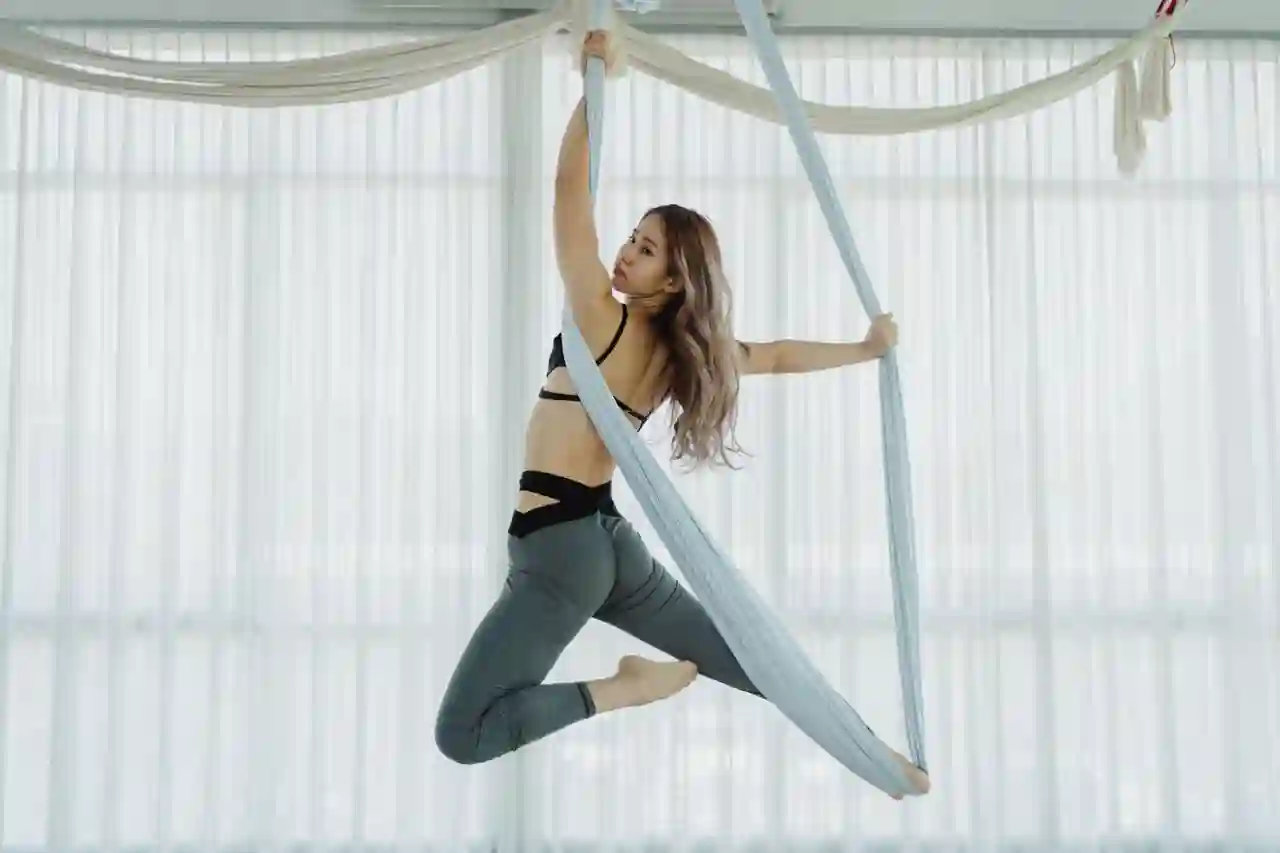
Yoga postures and breathwork practiced in a silk hammock hung about 3 feet off the floor.
Find your flow — suspended between earth and air.
At a glance
What it is
Yoga postures and breathwork practiced in a silk hammock hung about 3 feet off the floor.
Why explore it
The hammock adds traction and supported inversions for a unique gravity-assisted challenge.
How it’s experienced
Expect grounded and suspended poses, gentle swinging, and instructor-guided breathwork each class.
Evidence context
Early small studies hint at flexibility and mood benefits, but solid clinical evidence is still limited.
See the evidence snapshotSafety
Avoid if pregnant or hypertensive, and always learn inversions with a certified instructor present.
See staying safeHistory & Origin
Aerial yoga is a hybrid movement practice that combines traditional yoga postures, Pilates-inspired core work, and acrobatic elements using a fabric hammock suspended from the ceiling. The hammock — sometimes called a silk, sling, or trapeze — is typically anchored at hip height or higher, allowing practitioners to perform poses both on the ground and while partially or fully suspended in the air. This suspension element is said to decompress the spine, support deeper flexibility work, and introduce an element of play and embodiment that ground-based yoga may not offer in the same way.
Some practitioners and instructors suggest that working with the hammock may help reduce gravitational compression on the joints, making certain stretches and inversions more accessible than they would be on a mat. The practice often includes a blend of standing poses, seated stretches, core strengthening sequences, and full inversions — all performed in coordination with the silk. Sessions typically close with a supported relaxation posture inside the hammock, which many participants describe as deeply restorative.
Aerial yoga is generally approached as a wellness and fitness activity rather than a clinical therapeutic tool. While enthusiasts report benefits ranging from improved posture and flexibility to stress relief and a sense of emotional lightness, it is important to note that formal clinical evidence supporting these claims is currently limited. Anyone considering aerial yoga should consult a qualified healthcare provider before beginning, particularly if they have existing health conditions, and should always practice under the guidance of a trained instructor.
Aerial yoga as a structured practice is generally traced back to the early 2000s in the United States, with BessieKen Hannaford and Christopher Harrison among the figures often credited with developing and popularizing early aerial fitness and AntiGravity Yoga frameworks. Harrison, a Broadway choreographer and gymnast, is widely cited as a pioneer of AntiGravity Yoga, which he developed in New York in the late 1990s and early 2000s by adapting aerial acrobatics and therapeutic hammock techniques for a general fitness audience.
The practice draws from a much older lineage of yoga, which originated in ancient India and encompasses physical postures, breathwork, and philosophical traditions spanning thousands of years. It also borrows from aerial arts, circus performance traditions, and modern physical therapy concepts around spinal traction and decompression. Over the following decades, aerial yoga spread internationally, with numerous independent schools, teacher training programs, and stylistic variations emerging globally. Today it is practiced in yoga studios, fitness centers, and wellness retreats worldwide, though it remains a relatively niche offering compared to traditional floor-based yoga styles.
Mechanism
Aerial yoga works by using a suspended fabric hammock to support, challenge, and reposition the body through a blend of yoga-inspired movement and partial or full suspension.
Your first visit
A typical session outline to help you feel prepared
Aerial yoga combines movement, breath, and gravity using a silky fabric hammock — expect to feel supported, stretched, and surprisingly blissful by the end.
Your instructor greets you, checks for any injuries or health concerns, and walks you over to your hammock, showing you how it's rigged and how much weight it safely holds.
You'll practice simply sitting in and leaning on the hammock with both feet on the ground, learning to trust the fabric before any real movement begins.
The class opens with gentle standing and seated stretches using the hammock as a light support, warming up your spine, hips, and shoulders before you leave the floor.
You'll move into beginner poses like low-flying lunges and supported folds where the hammock cradles your hips or back — you'll feel a satisfying traction through your spine.
With instructor guidance you'll try a gentle inversion, allowing your spine to fully decompress — most first-timers describe it as an immediate feeling of length and relief.
The hammock is adjusted to support your lower back as you open your chest skyward in a restorative backbend, which often feels deeply releasing for the upper body.
To close, you wrap yourself fully inside the hammock like a cocoon and sway gently — this zero-pressure rest is one of the deepest relaxation experiences in any yoga class.
Your instructor helps you out of the hammock and offers a moment to reorient, reminding you to hydrate and noting that mild muscle soreness from the novel movements is normal.
The Evidence
What current research says about aerial yoga, where the evidence is limited, and what to keep in mind before starting.
Early-stage research with promising signals, not firm conclusions
Aerial yoga has a small preliminary research base covering flexibility, balance, and well-being, but most studies are small, short-term, and lack control groups. Positive findings are noted but cannot yet be considered definitive.
Small-scale pilot studies and observational reports have explored aerial yoga's potential effects on flexibility, core strength, and psychological well-being. These findings are encouraging but constrained by small samples, short follow-up periods, and limited methodological rigour. Independent peer-reviewed trials are needed before stronger claims can be made.
As a holistic modality, aerial yoga integrates physical conditioning, body awareness, and elements of play and presence. Practitioners often report a sense of embodiment and stress relief alongside the physical work. These experiential dimensions are meaningful to many participants, even where formal evidence remains limited.
Developed in the late 1990s and early 2000s, aerial yoga draws from classical yoga traditions originating in ancient India, circus and aerial performance arts, and contemporary movement science. Figures such as Christopher Harrison helped shape early frameworks. It is a relatively young practice without the deep historical evidence base of older traditional systems.
Falls, inversion-related pressure changes, and equipment failure are real risks, particularly for beginners. Always practice with a certified instructor in a properly equipped studio. Contraindications include pregnancy, uncontrolled hypertension, glaucoma, severe osteoporosis, inner ear disorders, and recent surgery. Disclose your full health history before your first session.
Individuals with cardiovascular conditions, herniated discs, spinal pathologies, or active vertigo should consult a qualified health professional before participating. Inversions increase intracranial and intraocular pressure, making them unsuitable for those with glaucoma or related conditions. When in doubt, seek professional assessment before joining a class.
Aerial yoga has not been evaluated as a clinical intervention for any specific health condition and should not be understood as a substitute for professional medical assessment or care. Claims about spinal decompression and therapeutic benefit are largely based on practitioner experience and theoretical rationale. Approach inflated outcome claims with appropriate scepticism.
Safety first
General guidance to help you decide whether this approach is appropriate for you. This is informational only and not a substitute for medical, psychological, or professional advice.
If you are experiencing severe distress, suicidal thoughts, psychosis, acute trauma, or another serious mental health concern, seek qualified support first.
This approach is not suitable for diagnosis, treatment instructions, or decisions that require medical, legal, financial, or professional advice.
Look for clear boundaries, transparent pricing, and practitioners who avoid fear-based claims or pressure to book frequent sessions.
Treat any insight as one reflective perspective, not absolute truth. Important decisions should be considered with appropriate professional support.
For you?
A simple, human way to weigh it up. This is general guidance, not personal medical advice — a qualified practitioner can advise on your situation.
Gyfts is a discovery platform, not a medical provider. Nothing here diagnoses, treats or replaces professional care. In an emergency, contact your local emergency number.
Explore approaches
Other practices people often explore alongside aerial yoga.
In their words
Before you book
FAQ
Prior yoga experience is not required for most beginner aerial yoga classes, though basic body awareness and comfort with movement may help. Introductory sessions are typically designed to orient new participants to the hammock and cover foundational safety skills before advancing to more complex poses. Always let your instructor know if you are completely new to yoga or movement practices.
Some practitioners suggest that the hammock's gentle spinal decompression effect may feel supportive, but aerial yoga is not a medically validated treatment for back conditions. If you have a diagnosed spinal condition such as a herniated disc, spinal stenosis, or recent back surgery, you should consult your healthcare provider before participating. Certain poses and inversions may aggravate rather than relieve specific spinal issues.
Unlike traditional floor-based yoga, aerial yoga uses a suspended fabric hammock that allows for partial or full suspension during poses, which changes the mechanical demands on the body and introduces elements of aerial acrobatics and traction. This can make some poses feel more accessible while adding new challenges related to balance and spatial orientation. The playful and novel nature of the hammock is often cited as one of the practice's most distinctive features.
References
Educational sources that inform this overview. Inclusion is for context and does not imply endorsement.
Full citations are maintained by the Gyfts editorial team and reviewed periodically.
Keep exploring
Browse practitioners, explore honest overviews, and take what you learn to a conversation — at your own pace.