What it is
Prop-supported poses held for minutes, guiding your nervous system into deep, effortless rest.
Rest deeply. Restore gently. Recover fully.
At a glance
What it is
Prop-supported poses held for minutes, guiding your nervous system into deep, effortless rest.
Why explore it
It may ease stress, burnout, and poor sleep by gently activating your body's relaxation response.
How it’s experienced
Expect 4–6 fully supported poses held up to 20 minutes each in a 60–90 minute session.
Evidence context
Early studies show promise for stress and sleep, but larger research is still needed to confirm benefits.
See the evidence snapshotSafety
Low-risk for most people; adjust any pose that causes joint or lower back discomfort right away.
See staying safeHistory & Origin
Restorative yoga is a gentle, passive style of yoga that prioritizes deep relaxation over physical exertion. Unlike more dynamic yoga practices, restorative yoga uses props such as bolsters, blankets, blocks, and straps to fully support the body in each pose, allowing muscles to release tension without active effort. Poses are held for extended periods — typically five to twenty minutes each — with the intention of inviting the nervous system into a state of rest and recovery.
The practice draws from the broader tradition of Hatha yoga and was significantly shaped in the West by yoga teacher B.K.S. Iyengar, whose emphasis on precision and prop use laid the groundwork for what became known as restorative yoga. It is designed to be accessible to a wide range of individuals, including those who are new to yoga, recovering from illness or injury, managing chronic stress, or simply seeking a counterbalance to the demands of daily life.
Restorative yoga is often described as a practice of doing less to achieve more. By creating conditions for stillness and supported ease, practitioners may experience a reduction in physical and mental tension over time. Some practitioners and instructors suggest it may be associated with improved sleep quality, reduced feelings of anxiety, and a greater sense of overall well-being. While it is not a medical treatment, it is increasingly offered in integrative health settings as a complementary practice alongside conventional care.
Restorative yoga has its roots in the classical Hatha yoga tradition of India, which has long included practices aimed at balancing effort with surrender. The modern form of restorative yoga as practiced in the West was heavily influenced by B.K.S. Iyengar, an influential Indian yoga teacher who pioneered the therapeutic use of props to make postures accessible to individuals with injuries, illness, or limited mobility. His approach emphasized that yoga could be a healing practice when adapted thoughtfully to the individual body.
Judith Hanson Lasater, an American yoga teacher and physical therapist, is widely credited with further developing and popularizing restorative yoga as a distinct practice in the 1970s and 1980s. She formalized many of the prop-supported poses and sequences still commonly used today. Over the decades, restorative yoga has grown beyond studio settings and is now offered in hospitals, cancer centers, veterans' programs, and corporate wellness environments, reflecting a broader cultural interest in rest, stress recovery, and mind-body practices.
Mechanism
Restorative yoga is thought to work by creating the physical and mental conditions that may support nervous system regulation and deep muscular release.
Your first visit
A typical session outline to help you feel prepared
A gentle, unhurried practice where your body is fully supported in a handful of poses so you can sink into deep rest and renewal.
Your teacher greets you and asks a few simple questions about any injuries, areas of tension, or intentions you're holding for the session. This helps them suggest prop adjustments that suit your body.
You'll collect bolsters, folded blankets, blocks, and possibly an eye pillow from a communal prop area. Your teacher may help you build a small nest of support materials before the first pose.
Lights are dimmed, soft music or silence fills the room, and you find a spot on your mat. You're encouraged to wear comfortable, warm layers since your body temperature can drop as you become still.
Your teacher guides you into the first posture, often a gentle supported recline or chest opener, and helps you position bolsters and blankets until everything feels effortless. There is nothing to hold or engage.
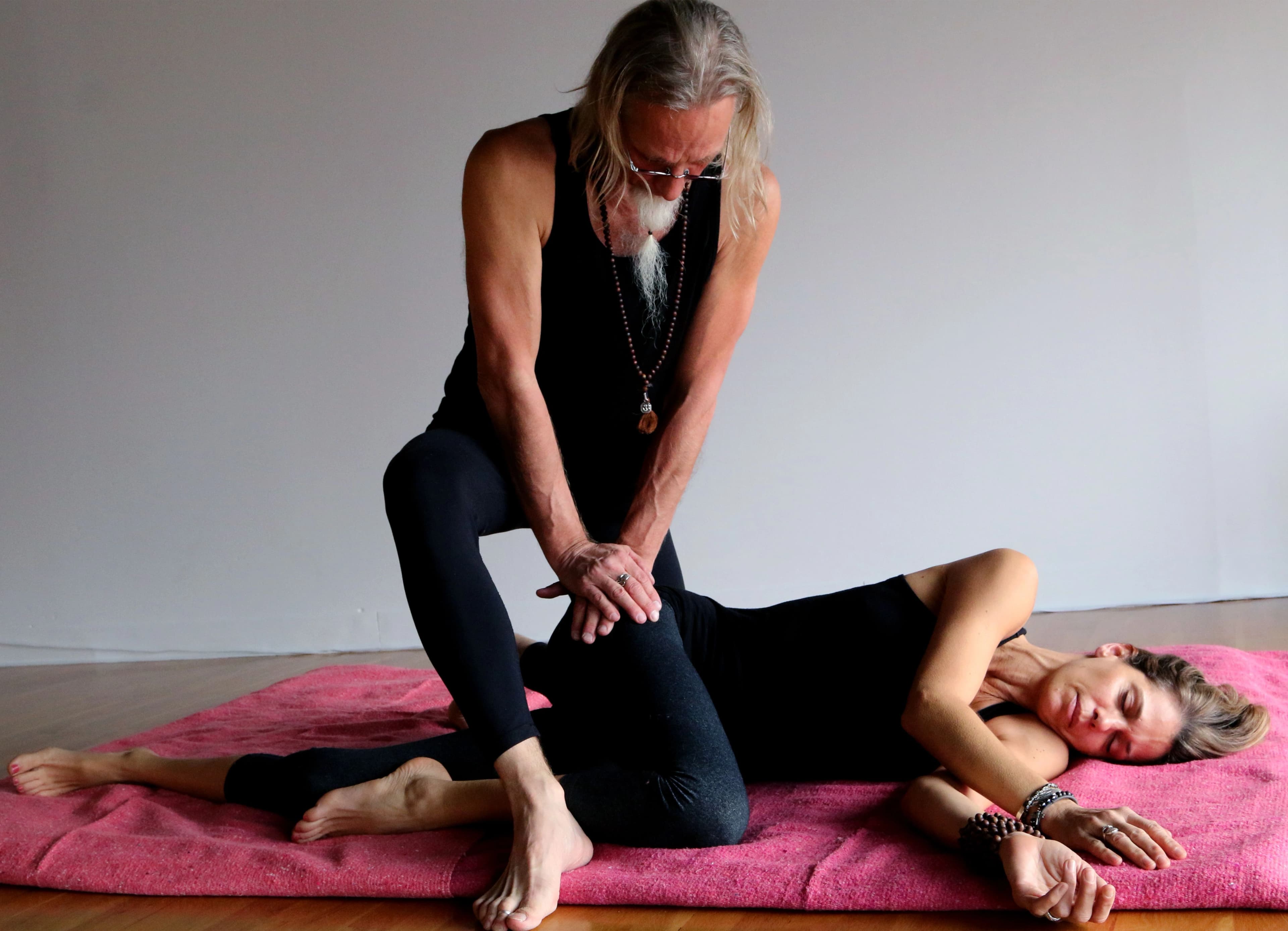
You remain in each pose for five to twenty minutes while your nervous system gradually shifts into a restful state. Your teacher may quietly offer small prop tweaks or a gentle adjustment if you'd like.
The session typically includes three to five poses total, such as a supported forward fold, a gentle twist, and legs-up-the-wall. Transitions are slow and unhurried, with time to notice how you feel between each shape.
The session closes with several minutes in Savasana, lying flat and fully blanketed. An eye pillow over your eyes signals your body that it's safe to fully release any remaining mental or physical holding.
Your teacher softly guides you back to waking awareness, and you take your time sitting up. Most people feel calm, a little spacey, and deeply rested, so plan for a quiet transition before driving or rushing anywhere.
The Evidence
What research currently says about restorative yoga, where the evidence is strong, and where gaps remain.
Promising early findings, but research is still maturing
Restorative yoga has shown encouraging associations with reduced stress, improved sleep, and lower fatigue in early studies. However, most research involves small samples and self-reported outcomes, so conclusions should be held lightly until larger trials are completed.
Small-scale studies suggest restorative yoga may be associated with reduced perceived stress, improved sleep quality, and lower fatigue — particularly in people managing cancer-related fatigue and chronic stress. Most studies lack active control groups and rely on self-report, which limits how much weight can be placed on findings. Larger, well-designed trials are needed.
Integrative medicine researchers have shown interest in restorative yoga due to its tolerability and low-risk profile. It appears in hospital, cancer centre, and veterans' wellness programmes as a supportive addition to standard care. It is not a substitute for professional assessment or medical management of any condition.
The practice is grounded in the idea that supported stillness may activate the parasympathetic nervous system, shifting the body toward rest and recovery. This whole-person orientation — addressing physical tension, mental load, and emotional regulation together — reflects a holistic approach that sits comfortably within the MACH framework.
Its foundations lie in Hatha yoga's emphasis on balancing effort with surrender. B.K.S. Iyengar's therapeutic use of props and Judith Hanson Lasater's subsequent work formalised restorative yoga as a distinct practice. Understanding this lineage helps contextualise both its philosophy and its practical approach.
People with glaucoma should avoid inverted or head-lowered positions. Those with reflux, late-stage pregnancy, or respiratory conditions should consult a healthcare provider before starting. Any joint or back discomfort during a held pose should prompt immediate repositioning. Always inform your instructor of relevant health conditions before your session.
Without larger randomised controlled trials and active comparator groups, it is not possible to determine whether benefits are specific to restorative yoga or shared with other rest-based practices. Inflated outcome claims should be viewed with caution. The practice's value is best understood as supportive and complementary rather than curative or definitive.
Safety first
General guidance to help you decide whether this approach is appropriate for you. This is informational only and not a substitute for medical, psychological, or professional advice.
If you are experiencing severe distress, suicidal thoughts, psychosis, acute trauma, or another serious mental health concern, seek qualified support first.
This approach is not suitable for diagnosis, treatment instructions, or decisions that require medical, legal, financial, or professional advice.
Look for clear boundaries, transparent pricing, and practitioners who avoid fear-based claims or pressure to book frequent sessions.
Treat any insight as one reflective perspective, not absolute truth. Important decisions should be considered with appropriate professional support.
For you?
A simple, human way to weigh it up. This is general guidance, not personal medical advice — a qualified practitioner can advise on your situation.
Gyfts is a discovery platform, not a medical provider. Nothing here diagnoses, treats or replaces professional care. In an emergency, contact your local emergency number.
Explore approaches
Other practices people often explore alongside restorative yoga.
In their words
Before you book
FAQ
No prior yoga experience is required for restorative yoga. The practice is designed to be accessible to all levels, including complete beginners, as it focuses on supported stillness rather than physical skill or flexibility. A good instructor will guide you through every pose and offer modifications as needed.
Restorative yoga differs from most other yoga styles in that poses are fully supported by props and held with no muscular effort, with the primary goal being deep relaxation. Yin yoga also involves long-held poses but typically targets connective tissue and involves more sensation. Standard yoga classes, even gentle ones, generally involve more active engagement and movement than restorative yoga.
There is no universally established frequency, and individual responses vary. Some practitioners suggest that even one session per week may be associated with a noticeable shift in stress levels or sleep quality over time. Consistency is generally considered more important than frequency, and restorative yoga can be practiced alongside other forms of exercise or wellness activity.
References
Educational sources that inform this overview. Inclusion is for context and does not imply endorsement.
Full citations are maintained by the Gyfts editorial team and reviewed periodically.
Keep exploring
Browse practitioners, explore honest overviews, and take what you learn to a conversation — at your own pace.